
You’ve been sober for a while now. Maybe a year. Maybe three. Maybe more.
You’ve done the work. You rebuilt a life. You’ve stayed out of chaos.
And yet… something’s missing.
Not a relapse. Not a crisis. But a quiet disconnect. A kind of emotional drift that’s hard to explain—even to yourself.
You’re not alone in that feeling. Many of our alumni reach this point. The routines are there, the milestones checked off, but something inside feels flat. Like you’re surviving recovery instead of living it.
This is for you. A love letter to the part of you that wonders if it’s okay to want more—and to the part of you afraid that coming back means starting over.
It doesn’t.
At Foundations Group Recovery Center in Mashpee, MA, our Partial Hospitalization Program isn’t just for first-timers. It’s here for alumni, too—for reconnection, not repetition.
Long-Term Sobriety Can Be Emotionally Lonely
There’s a narrative in recovery that once you get a year, or five, you’re golden. That the hard part is over.
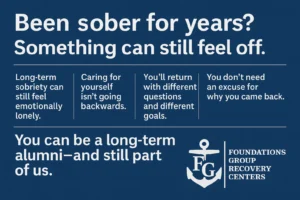
But what no one tells you is this: long-term recovery comes with its own kind of ache. The kind that shows up quietly.
You’re no longer in survival mode. And that’s good. But it also means emotions you couldn’t afford to feel in early recovery start surfacing now:
- Flatness
- Loneliness
- Disconnection from joy or meaning
- A sense that you “should” feel better than you do
That’s not regression. That’s progress asking for deeper work.
You’re Not Failing. You’re Listening.
If you’re reading this, it means something inside you is stirring.
That’s not failure—it’s awareness. It’s the part of you that’s evolved enough to notice when things are emotionally off.
Coming back to structured care isn’t about fixing something broken. It’s about tuning back in. Making space for reflection, for support, for the kind of growth that requires more than just going to meetings and checking in with a sponsor.
If you’ve been thinking about re-engaging with support, it’s probably because you’re ready for the next layer—not because you’re back at square one.
What Returning to PHP Looks Like for Long-Term Alumni
If you hear “Partial Hospitalization Program” and think of detox, relapse, or first-time treatment—you’re not alone. But PHP isn’t just for stabilization. It can be a powerful space for recalibration.
Here’s what it can look like when long-term alumni return to PHP:
- A short-term structure to support emotional depth work
- Trauma-focused care that wasn’t available or safe during early sobriety
- Support navigating big life changes: grief, divorce, parenting, career shifts
- A place to get real without feeling like you’re “overreacting” or “should know better”
You bring different questions now. And PHP can meet you with different answers.
You’re Not Repeating—You’re Reclaiming
Let’s be clear: you’re not starting over.
You already know how to stay sober. You know what works and what doesn’t. You know how to show up, even when it’s hard.
But maybe you’ve lost connection to why you’re sober. Maybe you miss the clarity of early recovery, the groundedness of being deeply supported. Maybe you just want someone to ask, “How’s your soul doing?” and mean it.
Returning to PHP isn’t about re-learning the basics. It’s about reclaiming your emotional footing. Your sense of aliveness. Your connection to yourself.
You Don’t Have to Explain Why You Came Back
Many alumni hesitate to reach out because they can’t “justify” it. They haven’t relapsed. Their life isn’t on fire. They’re still showing up to work, raising kids, staying accountable.
But you don’t need to earn your way back. You don’t have to be in crisis to need care.
Here’s what some of our returning alumni have said:
- “I’m just… tired. All the time.”
- “I feel like I’m doing recovery, not living it.”
- “I’m not using, but I’m not okay either.”
That’s reason enough. You don’t have to explain more than that.
The Work Is Different Now—So Is the Support
In early recovery, the focus is often survival, stabilization, and building structure.
In long-term recovery, the focus shifts:
- Who am I now that I’m not in constant crisis?
- What am I doing with my emotional energy?
- Why does life feel flat even when it’s “good”?
- How do I reconnect with purpose or spirituality?
These aren’t beginner questions. They’re deep, brave, seasoned questions. And you deserve seasoned care to explore them.
At Foundations Group Recovery Center, our Partial Hospitalization Program gives space for that kind of exploration—without stripping away your autonomy or treating you like a “client starting over.”
You’re Not the Only One Who’s Come Back
There’s power in knowing you’re not alone. Many of our alumni come back—not because they failed—but because they grew.
They grew into a version of themselves that needed new tools, deeper support, or just a place to feel again. Some needed two weeks. Others stayed longer. But all of them walked in with a similar ache:
“Something’s off. And I’m ready to do something about it.”
That’s not weakness. That’s recovery maturity.
You’re Still Part of This Community
Whether you came through six months ago or six years ago—you’re still part of this place. You helped shape it. And you still belong here.
If you’re in or near Barnstable County or Falmouth, MA, you don’t need to look far. We’re local. We’re real. And we’re still here—quietly cheering you on, whether you call or not.
But if you do call… we’ll answer with open arms.
FAQs: Coming Back to PHP as a Long-Term Alumni
Do I have to be in crisis to return to PHP?
No. Many alumni come back just to reconnect, recalibrate, or work through emotional stuck points. You don’t need to be in active relapse to benefit.
Will I have to do the whole program again?
Not necessarily. We personalize your re-entry. Depending on your goals, you might engage for a short stretch, a full PHP schedule, or a custom plan built around your current needs.
Will I be treated like a beginner?
No. We respect your time in recovery. The work you’ve already done matters. You won’t be asked to rehash old content unless it supports your growth.
Can I focus on emotional health, not just substance use?
Yes. In fact, many returning alumni come for mental, emotional, and spiritual support—not because substance use restarted.
What if I’m not sure I need this?
That uncertainty is part of it. You don’t need certainty—you need curiosity. A quick call or consult can help you explore whether this kind of support feels right.
Ready to Come Back—Without Starting Over?
Call (844)763-4966 or visit our Partial Hospitalization Program page to explore what returning to care could look like—for your current season of recovery. You’re not behind. You’re just ready for more.