
I never thought I’d be the one Googling “partial hospitalization program for young adults near me” at midnight.
I never thought I’d be the one sitting on the floor of my laundry room, crying silently so no one would hear me, phone in hand, staring at the number of a treatment center. I hovered over that call button for days.
Because making that call felt like crossing a line I wasn’t ready to cross. It felt like saying, Yes, my kid is in crisis. Yes, I need help. Yes, it’s bigger than us now.
And that terrified me.
But do you know what terrified me more?
Doing nothing.
I Was Waiting for Something to Make the Decision for Me
For months, we told ourselves it was just anxiety. Just stress. Just college. Just hormones. Just them being 20-something.
But the “justs” stacked up fast. Missed classes. Broken windows. Shouting matches. Long silences. Long sleeves in summer. Lies. Then apologies. Then more lies.
We tried therapy. We tried tough love. We tried pretending it wasn’t that bad. But deep down, I knew we were losing them. And I was losing my grip on how to help.
I didn’t know what a Partial Hospitalization Program was. I didn’t know how to talk about “treatment.” But I knew this: something had to change before the worst thing happened.
PHP Was the First Thing That Didn’t Feel Like Giving Up
When someone first mentioned PHP, I pushed back.
It sounded clinical. Intense. Like something for “those other families” who had kids with diagnoses, or who’d been to psych wards. Not us.
But after one honest call to Foundations Group Recovery Center, I realized I’d been wrong.
This wasn’t inpatient lockdown. It wasn’t a place where your kid vanishes for 30 days.
It was a structured, day-based program—about 6 hours a day, 5 days a week—where young adults could get real, consistent help while still coming home at night.
It wasn’t about giving up control. It was about getting a grip before things got worse.
We Needed More Than Therapy—We Needed Stability
My child had been in therapy for over a year. But let’s be honest: once a week for 50 minutes isn’t enough when you’re unraveling daily.
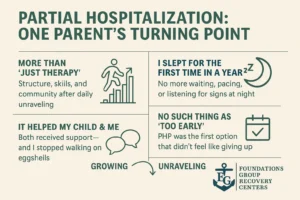
PHP created structure where we had none. It gave them a reason to get up in the morning. A reason to leave their room. A reason to engage with other people in real life, not just in chat servers or social feeds.
They had group therapy. Individual sessions. Medication check-ins. DBT skills. Relapse prevention. Family meetings. Supportive staff who didn’t treat them like a diagnosis.
And most importantly?
They weren’t alone anymore.
If you’re in Barnstable County, MA, this kind of day-treatment support isn’t hours away. It’s here. And it matters more than you think.
I Stopped Waking Up in a Panic
When your kid is in crisis, sleep becomes an act of faith.
You listen for footsteps. For doors closing. For the silence that lasts too long. You check their breathing. You check their text messages. You don’t even know what you’re looking for—you just know you can’t look away.
But once my child started PHP, something shifted.
Not overnight. Not perfectly.
But I knew where they were during the day. I knew they were being monitored. That someone else was seeing what I’d been carrying alone.
And I started to sleep.
Not deeply. Not always.
But enough to remember what peace felt like.
The Program Didn’t “Fix” Them—But It Gave Them Back to Us
PHP isn’t a magic wand. It didn’t erase my child’s anxiety. Or their trauma. Or their impulsive streak. But it helped them name what they were feeling instead of acting it out.
It gave them space to talk to people who weren’t me. People who weren’t emotionally entangled. People who could challenge them without shutting them down.
It gave them a place where they weren’t “too much” or “a mess” or “a problem.”
And slowly—so slowly—they began to want to get better.
If you’re searching for a Partial Hospitalization Program in Falmouth, MA, please hear this: It is not too late. Even if they’re resistant. Even if they’re angry. Even if you’re the only one who thinks help is needed right now.
You’re allowed to start the process. You’re allowed to make the first call.
I Learned How to Stop Walking on Eggshells
This wasn’t just about my kid. I needed help too.
I needed someone to tell me it was okay to set limits. That I could say “no” without being cruel. That I could love my child without rescuing them from every consequence.
Foundations didn’t just support my kid—they supported me.
They helped me move from panic to plan. From fear to action. From total reactivity to something that almost resembled calm.
They didn’t just teach me about PHP. They taught me how to be a parent again in the middle of crisis—and after it.
There’s No Shame in Needing More Help
I used to think PHP meant failure. That it was proof I couldn’t hold it together. That we were a “treatment family” now.
But what I’ve learned?
There’s no shame in doing whatever it takes to keep your kid alive, stable, and growing.
No shame in saying “we need help.”
No shame in calling a place like Foundations and saying, “We’re not okay.”
Because most of the time? The people answering the phones have been there too.
FAQs for Parents Considering a Partial Hospitalization Program
What is PHP exactly?
PHP stands for Partial Hospitalization Program. It’s a structured day-treatment model that includes therapy, medication support, and group work. Clients attend during the day and return home at night.
Does my child have to agree to go?
Not always. Sometimes parents initiate PHP when the situation is urgent. Other times, a conversation with the treatment center can help persuade a reluctant young adult to give it a try. Engagement often grows once they’re in.
How long does PHP last?
Programs typically last between 2 and 4 weeks, though some stay longer. Progress is reviewed regularly and decisions are made collaboratively with the family and care team.
Will I be part of the process?
Yes. At Foundations, family involvement is considered essential. You’ll be invited into sessions, kept informed, and offered your own support.
What if we’ve tried therapy before and it didn’t help?
PHP offers more intensity, structure, and support than weekly therapy. It’s a different level of care—often the exact shift needed to help a young person move forward.
What if we don’t live right in Mashpee?
Many families travel from surrounding areas. If you’re in Barnstable County or Falmouth, MA, daily attendance is still very realistic—and sometimes essential.
Is this confidential?
Yes. PHP is a medical service covered by HIPAA. Everything your child shares is confidential, with certain exceptions around safety.
You’re Not Overreacting. You’re Responding.
Call (844) 763-4966 or visit our Partial Hospitalization Program in Mashpee, MA to learn how we support families and young adults through mental health crises—with steadiness, compassion, and tools that last.
You don’t have to hit rock bottom to ask for help.
Sometimes the bravest thing a parent can do is say: this is enough. And then, take one more step forward.