
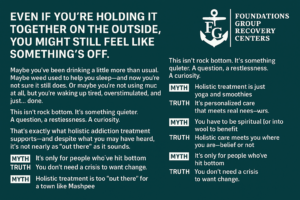
Even if you’re holding it together on the outside, you might still feel like something’s off.
Maybe you’ve been drinking a little more than usual. Maybe weed used to help you sleep—and now you’re not sure it still does. Or maybe you’re not using much at all, but you’re waking up tired, overstimulated, and just… done.
This isn’t rock bottom. It’s something quieter. A question, a restlessness. A curiosity.
If you’re reading this, you’re probably not looking for a dramatic life overhaul. You’re looking for options. You’re wondering if there’s a version of you that feels clearer, more grounded, less numbed-out.
That’s exactly what holistic addiction treatment supports—and despite what you may have heard, it’s not nearly as “out there” as it sounds.
Myth #1: Holistic means anti-science or anti-medication
Truth: Holistic care adds to evidence-based treatment—not replaces it.
Let’s get this cleared up first. “Holistic” doesn’t mean “unverified.” It doesn’t mean ditching your therapist or flushing your meds. And it definitely doesn’t mean replacing trauma-informed care with essential oils.
At Foundations Group Recovery Centers in Mashpee, holistic care is an integrated model. That means you get everything that traditional treatment offers—like individual therapy, group work, medical support—and you also get tools that support your nervous system, stress response, nutrition, and emotional resilience.
We’re not guessing here. Studies continue to show that combining clinical therapy with practices like mindfulness, movement, and creative expression leads to better outcomes, especially in early recovery or when someone is exploring sobriety for the first time.
As one client put it:
“I thought it would be all floaty stuff. But I got a real therapist, a plan that made sense, and a way to finally hear myself think again.”
Myth #2: Holistic treatment is just yoga and smoothies
Truth: It’s personalized care that meets real needs—yours.
Yes, we offer yoga. And yes, we like green smoothies. But that’s not what defines holistic care.
What makes it holistic is the commitment to treating you as a full human being—not just a list of symptoms or behaviors.
Depending on your needs, holistic addiction treatment in Mashpee might include:
- Mind-body practices: mindfulness, gentle movement, breathing techniques
- Creative therapies: art, journaling, music, guided imagery
- Nutrition education: practical ways to support mood and energy through food
- Sleep and stress support: so you can rest instead of scroll
- Trauma-informed bodywork: ways to reconnect with your body in a safe way
- Nature-based grounding: walks, sunlight, beach-based reflection if available
No two clients follow the same track. Some want structure and therapy first. Others want to start with movement or quiet self-reflection. Either way, we listen. We adjust. We don’t push what doesn’t feel useful.
Because when people feel seen, they start to show up. And when they show up, things start to shift.
Myth #3: You have to be spiritual (or into woo) to benefit
Truth: Holistic care meets you where you are—belief or not.
Let’s be honest. The word “holistic” sometimes carries baggage. You might be picturing a room full of crystals, people chanting in a circle, or someone telling you to “just breathe” when your anxiety is climbing the walls.
That’s not what we do here.
There’s no required belief system. No spiritual pitch. Just space. For silence. For questions. For figuring out what helps you feel okay.
We’ve worked with clients who find peace in journaling. Others feel safe only in movement. Some use prayer. Some don’t. Some find clarity in a quiet walk through the woods. Others find it in honest group therapy and laughter.
Holistic means full-person. And full-person care means you don’t have to believe anything to begin. You just have to be curious.
Myth #4: It’s only for people who’ve hit bottom
Truth: You don’t need a crisis to want change.
This one might hit close. If you’re sober curious, you’ve likely thought:
“I don’t really have a problem.”
“I haven’t lost anything.”
“Other people need treatment—not me.”
And that might be true. You might not be in danger. You might be functioning. But “functioning” isn’t the same as thriving.
Holistic care isn’t about labeling you. It’s about supporting you while you figure things out. You can explore, test, scale back, learn—and you don’t have to wear a diagnosis like a badge.
In fact, many of our clients come to us saying:
“I’m not sure if I belong here.”
And our answer is always:
“If you’re wondering that, you probably do.”
Recovery isn’t always about stopping. Sometimes it’s about starting—starting to listen to yourself, to respect your body’s signals, to wonder what life feels like without substances constantly running in the background.
Myth #5: Holistic treatment is too “out there” for a town like Mashpee
Truth: It’s already here—quietly, effectively, and working.
We get it. Mashpee isn’t L.A. or Boulder. But healing doesn’t have to come with a brand or a lifestyle.
Here in Mashpee, holistic treatment looks like:
- A quiet group room with natural light
- A yoga mat rolled out in a corner, not a stage
- A therapist who asks how your body feels, not just what your brain thinks
- A team that notices when your energy dips or your tone tightens
It looks like respect. For your pace. For your questions. For your humanity.
If you’re nearby in Falmouth MA or Barnstable County MA, know this: support exists right where you are. And it’s not trying to change you. It’s here to support the version of you that already wants to change something.
Frequently Asked Questions (FAQ)
What is holistic addiction treatment, really?
It’s an approach that combines traditional addiction treatment (like therapy, support groups, and medical care) with complementary practices that support emotional, physical, and spiritual wellbeing. Think of it as a “yes, and” model—therapy and movement, support and mindfulness, clarity and curiosity.
Do I have to stop drinking or using completely to join?
No. If you’re sober curious, you’re welcome to explore without commitment or labels. Many people come simply wanting to better understand their patterns or reduce use in a supported way.
Is this covered by insurance?
In most cases, yes. Many holistic elements are integrated into our outpatient and intensive outpatient programs. Our team can verify benefits and walk you through what’s included.
What if I’ve never done therapy or yoga before?
You don’t need experience. Most of our clients are trying these things for the first time. We guide, explain, and let you set the pace.
What if I’m not “addicted”?
That’s okay. Many clients aren’t. Sober curiosity is valid. Wanting to feel better is valid. You don’t need a diagnosis to deserve support.
You Don’t Need to Be “Sure” to Get Support
You don’t need a dramatic story. You don’t need to swear off substances forever. You don’t need to perform transformation to begin healing.
All you need is a question you’re willing to follow. A curiosity you’re ready to explore.
At Foundations Group Recovery Centers in Mashpee, we’re here to support you without pressure, diagnosis, or expectation. Whether you’re wondering, scaling back, or starting fresh, holistic addiction treatment can offer something surprisingly grounded:
A place to feel better—without becoming someone else.
Call (844)763-4966 or visit our Holistic Addiction Treatment page in Mashpee, MA to learn more.