
It takes guts to admit you need help. But even after that decision, the questions don’t stop. You might be wondering: What actually happens in treatment? What is IOP? Will it even help?
If you’re imagining a bunch of strangers sitting in a circle, passing around clichés and nodding politely—you’re not alone. That’s the stereotype. But it’s not the truth.
At Foundations Group Recovery Center in Mashpee, MA, our Partial Hospitalization Program and IOP options offer structure, skill-building, and a path forward. And none of that starts with pretending you’re fine.
Myth: “It’s Just Sitting Around Talking”
Truth:
Yes, you’ll talk. But not just to vent or fill time. In IOP, you learn and practice things like:
- How to respond to triggers without spiraling
- What to say when someone invites you out for a drink or a hit
- How to manage stress without reaching for substances
- How to build trust again—with yourself, and with others
Every group, every session, every tool is designed to help you move forward. There are moments of silence, yes—but also role-play, reflection, relapse prevention plans, and emotional skills that stick.
Myth: “You Have to Be Fixed Already to Start”
Truth:
You don’t need to be strong or ready or sure. You just need to be here. IOP is built for people who are in the messy middle—those who know they want help but still feel unsure, scared, or overwhelmed.
This isn’t a prize you earn for already doing well. It’s where the healing begins.
“I thought I needed to get my act together before I came. But they met me exactly where I was. Broken, scared, still using. That’s when things started to change.”
— Former Client, Mashpee IOP
Myth: “It Doesn’t Really Count as Treatment”
Truth:
This one gets under our skin.
Intensive Outpatient Programs are real treatment. So are Partial Hospitalization Programs. They’re not watered-down versions. They include clinical therapies like:
- Cognitive Behavioral Therapy (CBT)
- Dialectical Behavior Therapy (DBT)
- Trauma-informed care
- Family counseling
- Psychoeducation
You’ll also meet regularly with a therapist, a case manager, and sometimes even a medication provider if that’s part of your plan.
Want real treatment without 24/7 lock-in? Our Partial Hospitalization Program in Barnstable County, MA provides full-day support with the flexibility to return home at night.
Myth: “It’s Just for People Who Relapsed”
Truth:
IOP isn’t rehab’s consolation prize.
Many people enter treatment for the first time through IOP or PHP. Why? Because it’s accessible, supportive, and still allows you to keep parts of your daily life going—like caring for your family, going to work part-time, or living at home.
IOP is a first step for some and a second chance for others. Both are valid. Both deserve respect.
Myth: “I Already Tried Treatment. It Didn’t Work.”
Truth:
If you’ve done treatment before and it didn’t stick, you may be carrying shame. But listen: treatment isn’t a vending machine. You don’t put in 30 days and expect everything to spit out clean and healed.
IOP offers a fresh take. A different pace. New people. More tools. Maybe now, you’re ready in a way you weren’t before. That counts.
You don’t have to be convinced it’ll work. You just have to be willing to try again.
Myth: “I’ll Have to Pretend I’m Stronger Than I Am”
Truth:
This might be the most damaging myth of all.
You don’t need to “hold it together” in IOP. In fact, that mask? It’s one of the first things we help you take off. Recovery requires honesty—yes—but it also requires safety. And that’s what good IOP provides: a safe space to fall apart without falling behind.
In groups, you’ll hear stories that sound eerily close to yours. You’ll cry sometimes. You’ll laugh too. And bit by bit, pretending becomes unnecessary.
Looking for support in your area? We offer a trusted Partial Hospitalization Program in Falmouth, MA that’s known for its realness and respect.
So What Is IOP, Really?
Imagine you’re learning to walk again after an injury. IOP isn’t just talking about walking—it’s the rehab, the stretching, the practice steps with a guide beside you. You don’t just learn sobriety in theory. You live it, day by day, with support.
In IOP and PHP at Foundations Group Recovery Center, you’ll:
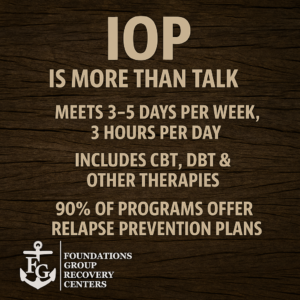
- Attend 3–5 days a week of structured programming
- Work with therapists, case managers, and group facilitators
- Develop a personalized treatment plan
- Learn, practice, and repeat recovery tools until they stick
- Go home each day and apply those skills in real life
You’re not just “staying clean”—you’re learning how to live differently.
Frequently Asked Questions About IOP
What’s the difference between IOP and PHP?
A Partial Hospitalization Program (PHP) typically involves more hours per week than IOP—often 5 days a week, around 6 hours a day. IOP is usually 3–5 days per week for 3 hours. Both offer real treatment without overnight stays.
Do I have to talk in group?
Not at first. You can observe until you feel ready. Over time, most people find themselves speaking up—because it starts to feel safe, not forced.
Will I still be able to work or take care of my family?
Yes. That’s the point. IOP and PHP are designed for people who need real treatment but also have responsibilities. We’ll help you build a schedule that works.
What if I relapse during IOP?
Relapse isn’t the end. It’s data. If it happens, we’ll address it—not punish it. You don’t get kicked out. You get supported.
Is IOP covered by insurance?
Often, yes. Many insurance plans cover IOP and PHP. We can verify your benefits and help you understand your options.
When You’re Ready to Get Real, IOP Is Waiting
It’s easy to think treatment has to look a certain way. But the truth? Real recovery rarely looks like TV rehab. It looks like showing up tired. It looks like failing and trying again. It looks like practicing being a version of yourself you forgot you could be.
If you’re ready to stop pretending, we’re ready to help.
📞 Ready to Talk?
Call (844)763-4966 or visit our Partial Hospitalization Program page to learn more about services in Mashpee, MA. You don’t have to do this alone—and you don’t have to have it all figured out to begin.