
I remember walking into meth addiction treatment wearing my tidy exterior like armor. I had a job. No arrests. I still showed up—barely. I told myself I was fine. That everything would hold. But on the inside, I was unraveling. If I didn’t stop soon, I’d collapse under the weight of living.
The first 30 days at Foundations Group Recovery Center near Mashpee, MA hit harder—and kinder—than I expected. Here’s what that first month felt like, day by day, in raw detail. Maybe this is the guide you needed to decide you deserve better too.
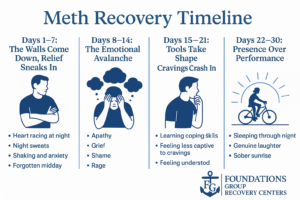
Days 1–7: The Walls Come Down, Relief Sneaks In
I walked in stiff—ready to resist anything that smelled like “help.” I felt ashamed I was walking in at all, because nothing had collapsed enough yet.
Then detox started. What followed was brutal:
- My heart thudded at night, like it couldn’t remember how to stop.
- Night sweats.
- Lunch jolts—where my hands shook and anxiety whispered everywhere.
- Midday fog that made me forget what kind of day it was.
But something unexpected happened that first week: I felt safe. I wasn’t being judged. No need to perform or dissociate. That strange sense—that I didn’t have to hide anymore—felt like relief. Relief enough to sink into.
Days 8–14: The Emotional Avalanche
Week two hit, and feelings smashed through the cracks.
Apathy. Grief. Shame. Rage. Self-loathing. Some mornings I couldn’t move. Others, I fluttered between highs and lows fast enough to make my head spin.
Group sessions were savage in their honesty:
- “I lost my kid’s graduation.”
- “I hit bottom in front of my mom.”
- “I’m afraid I’ll be that person again.”
I expected performance. But instead, raw voices. Tears. Apologies. Acceptance. The silence between us wasn’t judgment—it was witness. That silent witnessing became the anchor I didn’t know I needed.
Days 15–21: Tools Take Shape, Cravings Crash In
In the third week, life began to feel purposeful again. We learned tools for when cravings hit:
- Grounding, like feeling each toe on the floor.
- Breathing box 4‑7‑8.
- Checking in: “What do I need?” instead of “What do I want?”
Cravings didn’t disappear. They didn’t need to—they just didn’t scare me as much anymore. I felt less captive to them.
That week, someone lent me their pen mid‑craving share. That quiet act said, “I get you.” That was the tool I never knew I needed.
Days 22–30: Presence Over Performance
By week four, I started remembering what life felt like without constant panic or substance blur.
I stopped waking at 4 a.m.
My sentences finished.
I laughed in group—surprisingly, genuinely—two times.
My favorite breakthrough? Watching the sunrise sober on a bike outside the building. Feeling the cold air, the pink sky. Feeling alive again.
It didn’t erase the pain. But for a moment, it made everything worth it. I could breathe. I could choose.
Why These First 30 Days Matter
1. You aren’t disappearing from your life; you’re fixing it.
Here, they don’t rip up your calendar or cancel your appointments. You show up—to work, family, court—without pretending you didn’t need help.
2. You learn real coping, not slogans.
This isn’t recovery theater. It’s gritty practice: what to do when cravings hit during Tuesday’s Zoom meeting.
3. You begin trusting again.
After weeks of honesty, the connections—frail as they are—give you roots in something real.
What I’d Tell My Past Self
- You’re not weak. You’re worn out. Allow yourself to rest.
- Recovery isn’t punishment. It’s rehab—for your system, your spirit, your relationships.
- Cravings are signals—notice them, don’t fight them.
- Connection matters. Don’t wait for permission to feel.
Frequently Asked Questions
Q: Will I lose my job or responsibilities in 30 days?
A: Not if you plan ahead. Foundations coordinates with employers and offers flexible scheduling. You can preserve work or family commitments while getting care.
Q: When do cravings get easier?
A: They don’t vanish. But as coping tools build and your system stabilizes, cravings lose their power. They become moments, not takeovers.
Q: Is feeling terrible normal?
A: Absolutely. The emotional flood is the brain and body detoxing. It’s painful—but it’s a sign you’re healing.
Q: What if I relapse in those 30 days?
A: It’s not a failure; it’s more data. You talk about what happened and adjust your plan. Foundations supports resets without shame.
Q: How do I transition after 30 days?
A: You graduate into outpatient services, recovery coaching, alumni groups—designed to match your incrementally growing strength and independence.
Q: Why stay connected after detox?
A: Addiction rewires gradually. Ongoing support rewires more permanently. Recovery isn’t just to get clean—it’s to stay alive inside permanently.
In These 30 Days, You Start Choosing You
The calendar might say one month—but in those days, you begin remembering why you deserve to live sober.
The first day you feel calm. The first laugh without force. The first craving that didn’t win.
All of that matters.
You don’t have to wake up exhausted tomorrow.
Call (844) 763‑4966 to learn more about our meth addiction treatment services in Mashpee, MA. The first month’s hard—but it’s also where you begin to live again.