
You don’t need to be perfect to stay connected. You don’t need to avoid relapse forever to be in recovery.
You just need tools. Real ones. The kind you can reach for when things get messy—not just the ones that look good in a workbook.
If you’ve ghosted an Intensive Outpatient Program (IOP) before, or dropped out when life got too loud, this blog is for you. Not to shame you—but to show you what’s still possible. Even now.
At Foundations Group Recovery Centers in Mashpee, MA, we help clients build relapse prevention plans that are honest, human, and grounded in the reality of what it means to be in treatment and still struggle.
These skills can help you stay present, stay real, and stay connected—even if you’ve stumbled before.
1. Identify What Actually Trips You Up
Relapse isn’t just about substance use. It’s about what happens before the drink, the hit, or the pill.
Most people don’t relapse because they want to feel high. They relapse because:
- They feel overwhelmed and don’t know how to ask for help
- They miss one session and feel too ashamed to come back
- Their anxiety spikes, and they need something to calm it
- They believe one slip means they’ve “ruined it”
The first step in relapse prevention is naming your patterns—not just your triggers.
Ask yourself:
- What emotion do I avoid most?
- What’s usually happening the week before I slip?
- Do I isolate or shut down when I feel overwhelmed?
- Do I see relapse as failure or feedback?
Your answers help you create a prevention plan that’s actually about you, not just the behavior.
2. Build a Slip-Not-Spiral Toolkit
Here’s the truth most treatment centers won’t say: relapse might happen—especially early on.
That doesn’t mean you failed. It means you’re human.
The difference between a slip and a spiral is how you respond.
We help clients in IOP build a “Slip-Not-Spiral Toolkit” that includes:
- A safe person to text—even if you say nothing but “I messed up”
- A grounding action you can do in 5 minutes (walk, music, stretch)
- A self-talk line like, “This isn’t the end. I can still choose.”
- A re-entry plan that removes shame from the equation
Slips happen. Spirals don’t have to.
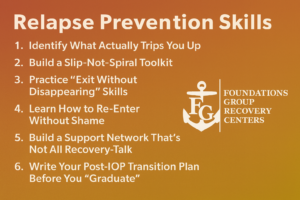
3. Practice “Exit Without Disappearing” Skills
If you’ve dropped out of a program before, chances are, you left without saying goodbye.
You didn’t mean to ghost. It just got hard, or messy, or too vulnerable.
But relapse prevention includes learning how to pause without disconnecting.
That might sound like:
- “I need a break. Can I talk to someone about it?”
- “I’m feeling like bailing—can I adjust my schedule?”
- “I missed a session and feel awkward. Can I still come back?”
Every time you communicate instead of disappear, you strengthen the muscle that helps you stay in recovery—even when you’re not feeling strong.
This is a huge part of the IOP process at Foundations Group, especially for clients in Barnstable County and Falmouth MA. We normalize pauses, detours, and honesty about struggle.
4. Learn How to Re-Enter Without Shame
One of the most overlooked relapse prevention skills is re-entry.
You relapse. You disappear. You start to think you can’t show your face again.
But here’s what we teach: you can come back without explaining, apologizing, or performing.
Seriously.
Clients return all the time with nothing but a head nod and a seat choice. That’s enough.
You don’t owe a redemption story to deserve support. Re-entry is a skill, and the only way to build it is to practice it. You’ll find no lectures here—just the next open chair.
5. Build a Support Network That’s Not All Recovery-Talk
It’s important to have people in your corner who get it—but also people who remind you who you are outside of recovery.
That’s part of relapse prevention too.
In IOP, we help clients identify two support tracks:
- Core circle: friends, alumni, clinicians who get the day-to-day recovery reality
- Identity anchors: people who reflect back your joy, humor, hobbies, or passions—outside of sobriety
Why does this matter?
Because when recovery feels like your only identity, any slip feels like total collapse. When it’s one part of a full life, a slip feels manageable—not defining.
6. Write Your Post-IOP Transition Plan Before You “Graduate”
Here’s a secret: one of the riskiest times in recovery is right after you finish IOP.
The structure is gone. The daily support is less. Everyone’s cheering—but you might be terrified.
That’s why we help clients create a transition plan before they leave, which often includes:
- Weekly check-ins or alumni meetups
- A “first 30 days” plan: how to handle weekends, holidays, tough days
- Continued therapy or wellness activities that help regulate your nervous system
- Emergency contact actions that feel accessible, not overwhelming
It’s not about keeping you dependent on treatment. It’s about helping you stay supported while you get steady.
7. Choose a Program That Respects the Messy Middle
Some IOPs will try to box you into a system—complete these steps, follow this timeline, stay “compliant.”
At Foundations Group in Mashpee, we do things differently.
We know that people who drop out are often the ones working the hardest. You’re doing emotional labor no one sees. You’re carrying shame from other places. You might be protecting yourself the only way you know how.
That doesn’t scare us. It informs how we show up.
If you return after relapse or pause, we don’t reset you to zero. We start from where you are. And we help you build relapse prevention skills that actually make sense for your nervous system, your patterns, and your life.
Frequently Asked Questions
I already relapsed—can I still come back to IOP?
Yes. We welcome clients back all the time. You won’t be judged or punished. You’ll be supported—period.
Will my insurance still cover treatment?
In most cases, yes. Our admissions team can walk you through coverage details and options for re-entry.
What if I left without saying anything—do I need to explain?
Not at all. You’re allowed to re-enter without explanation. We focus on where you are now, not where you’ve been.
Are relapse prevention skills really taught in IOP?
Absolutely. We integrate these skills into groups, one-on-ones, and discharge planning—so you’re not just learning what to do, but actually practicing how to do it.
Can I get support even if I’m not ready to rejoin yet?
Yes. Call us. You can ask questions, explore options, or just talk to someone about what’s next—without pressure.
Ready to Build Skills That Stick?
Relapse prevention isn’t a rulebook. It’s a relationship—with yourself, with your support team, and with the parts of you that still believe change is possible.
At Foundations Group in Mashpee, MA, we’re not here to grade you—we’re here to guide you.
Call (844)763-4966 or visit our Intensive Outpatient Program in Massachusetts to find out how to start again, or pick up where you left off.
Even if you’ve slipped. Even if you’re scared. Especially if you’re ready.